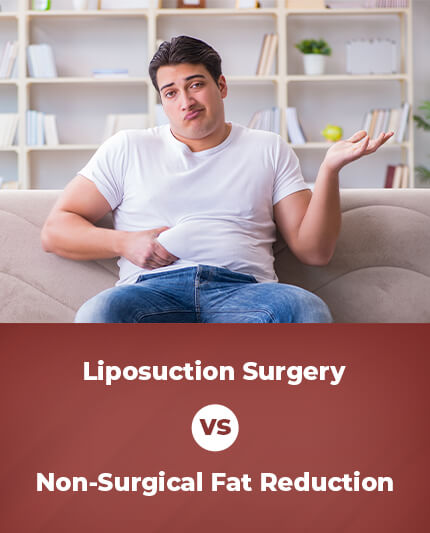
Most people don’t start thinking about fat-reduction treatments casually. It usually comes after months, sometimes years, of trying to fix one stubborn area that refuses to change. Diet improves. Exercise becomes consistent. And still, the lower abdomen, hips, thighs, or arms look exactly the same.
That’s the point where medical fat-reduction options enter the picture.
Two choices dominate these conversations today: liposuction surgery and non-surgical fat reduction treatments. Both aim to improve body shape, but they do it in very different ways and deliver very different outcomes.
Let’s clear up a common misconception early.
Neither liposuction surgery nor non-surgical fat reduction is meant for weight loss. These treatments don’t replace lifestyle changes, and they don’t work well unless your weight is already fairly stable.
They are meant for reshaping specific areas where fat distribution is resistant to exercise. Think of them as contour-correction tools, not weight-loss solutions.
Liposuction surgery removes fat cells directly from the body. Through small incisions, a surgeon uses a thin cannula to suction out excess fat and sculpt the area underneath.
Because the fat cells are physically removed, the change is immediate once swelling settles. When weight remains stable, those results tend to last.
Liposuction is now performed with more precision, control, and safety than ever before as techniques continue to evolve. Instead of an aggressive approach to fat elimination, the focus of liposuction is now on body contouring.
Liposuction has many different types of procedures due to differences in the areas to be treated, the type of fat located in those areas, and the skin quality of patients. The most commonly performed types of liposuction include:
The choice of which type of liposuction technique to use is less important than the surgeon’s skill in determining which technique is appropriate for the individual patient.
Liposuction is the best choice for reducing fat when:
For many patients who originally pursued non-surgical fat reduction options, the eventual desire to achieve significant physical change led to a final decision to undergo liposuction surgery.
Non-surgical fat reduction uses external devices or injections to damage fat cells gradually. The body then clears these cells over time through natural metabolic processes.
These treatments include fat freezing, ultrasound-based systems, radiofrequency devices, and fat-dissolving injections. There are no incisions and no anaesthesia.
The trade-off is subtlety. Results appear slowly and are usually modest.
Non-surgical fat reduction works best when:
These treatments are better suited for refinement than reshaping. They rarely deliver dramatic change, but they can smooth small problem areas.
The biggest difference lies in how much change you expect.
Liposuction physically removes fat, which makes outcomes more predictable. Non-surgical methods rely on gradual fat-cell breakdown, which limits how much reduction can occur.
Liposuction requires recovery. Compression garments, swelling, and short-term activity limits are part of the process. Non-surgical treatments allow people to return to routine almost immediately.
From a cost perspective, non-surgical treatments often look simpler upfront. Over time, repeated sessions can approach or exceed the cost of a single surgical procedure.
While fat-reduction procedures are frequently advertised as being easy to perform, the actual results of fat-reduction procedures vary considerably from one individual to another. Like any other medical intervention, the outcome will be based upon anatomical makeup, skin elasticity, and fat distribution patterns.
There’s no single “better” choice between liposuction surgery and non-surgical fat reduction. The right option depends on the amount of fat, the level of change you want, and how quickly you want to see results.
If defined, noticeable contouring is the goal, liposuction remains the more reliable option. If minor refinement without recovery time feels more appropriate, non-surgical treatments can be useful.
It bridges the gap between salon facials and medical procedures. It’s gentler than lasers or peels but far more effective than traditional facials. Ideal for anyone wanting a clean, hydrated, glowing finish without downtime.