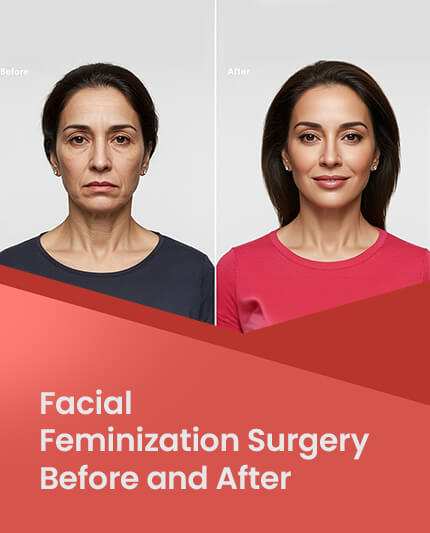
For many patients, especially transgender women and non-binary individuals, the face carries the most visible markers of gender. Hormones can soften certain features over time, but bone structure remains unchanged. That’s where facial feminization surgery before and after comparisons become powerful; they show what surgical contouring can realistically achieve.
This guide breaks it down clearly.
Common areas addressed during FFS surgery include:
Every patient’s plan is different. Some undergo one or two procedures. Others combine multiple corrections in a single surgical stage.
When people search for facial feminisation surgery before and after, they’re often trying to understand one thing: how dramatic will the difference be?
The answer depends on the starting structure and the procedures performed.
By changing the contour of the forehead and decreasing frontal bossing, a softer, smoother look will be created by the combination of the two. The expression as a whole will look a little more open overall because there is more depth to the eyes. The result will be a subtle but profound change in the overall contours of the face.
Men’s noses have wider bases and are often characterized by a stronger, wider bridge than women’s noses. Rhinoplasty performed as part of FFS surgery will focus on improving the nose so that it has more of a natural appearance, rather than drastically changing its size. The further to a naturally shaped nose, the more it will work with the new contour of the forehead.
A prominent jawline (square) or chin (large) can be created into a more tapered facial structure through contouring. Decreased width or projection (squared) at the chin will provide an overall oval shape to the face.
Hairline advancement shortens forehead height and frames the face more softly.
A tracheal shave reduces the visibility of the Adam’s apple, which can be an important part of the transformation.
When reviewing ffs before and after photos, you’ll often notice that the most powerful changes come from bone contouring rather than soft tissue procedures alone.
Results can range from subtle softening to significant transformation. The degree of change depends on:
Some patients want refinement. Others want a complete structural change. The surgical plan determines the level of transformation.
It’s important to understand that the goal of the best facial feminization surgery is not exaggeration; it’s natural harmony.
Yes. The structural changes made to the face are considered to be permanent as they involve the reshaping of bone and cartilage.
The core skeletal adjustments do not reverse.
The degree of scarring is dependent on the type of procedure performed.
If you have good planning prior to surgery and allow for good healing, you should have very little scarring, which will improve over time.
Facial feminization is highly specialised. It requires:
In order to get the best result, a consultation with your surgeon is necessary. As it is important to evaluate the proportions of your face in relation to your goals and what procedures would be used to provide a balanced overall appearance.
When reviewing facial feminization surgery before and after results, focus on balance, proportion, and harmony, not just dramatic change. The goal of Facial Feminization Surgery is to create facial structures that match a person’s sense of gender identity and do so in a safe, thoughtful manner.
If you’re considering facial feminisation surgery, a detailed consultation is the first step toward understanding what changes are possible for you personally.